Want to include some creative methods in your engaged research project for maximum impact with wider audiences? Great! I can work with you as part of a project team to input into the development and delivery of projects involving arts-based research methods.

We process images and symbols in a fraction of a second, compared to several second for text (Bratash et al., 2020; Petrova et al., 2020; Potter and Hagmann, 2015; Trafton, 2014)
Visual stories evoke emotion – they make us care (Wang et al., 2023)
We are far more likely to remember visual information several days later (Medina, 2014; DeLoache, 2004)
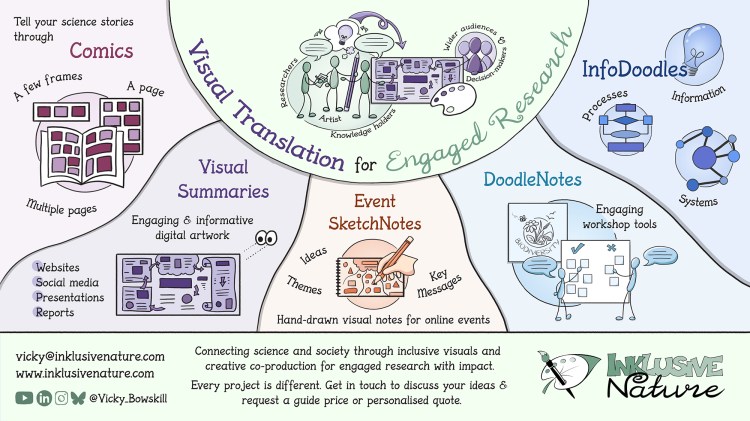
- SketchNoting is an accessible tool to bring academic ideas to a wider audience and engage non-academic partners with shaping and rolling out your project (Petrova et al, 2020; Fernández-Fontecha et al, 2019; Dimeo, 2016). They can be used as a method of co-creating research proposals and for communicating what you’ve learned. Simple sketches can be a unifying modality, crossing barriers of language, culture, education and ability.
- DoodleNotes can be used in place of plain sticky notes during development of a proposal as a fun way to develop and capture the views, priorities and stories of participants, who may find academic settings and language intimidating. Informal drawing can provide extra thinking space and elicit different perspectives compared to verbal or written interactions. Later the doodle notes can be explored through thematic analysis and used as a basis to feedback to participants on how they have influenced the research or project (Kearns et al, 2022).
- Visual summaries are very shareable on social media and are an engaging way to complement well-written lay summaries (Wada et al, 2020). They are also increasingly encouraged by journals to accompany academic publications. They can also be simply animated for engaging PowerPoint presentations, or to make a short video to publicise and celebrate project outcomes.
- Comics have been shown to be an effective medium for communicating scientific information in a very appealing and digestible way, increasing both engagement and retention of information (Fransman, 2024; Kearns et al, 2022; Kim et al, 2012). These could be just a few frames, or a number of pages for use either in print or online.
Want to find out how this might fit your next project? Get in touch.
References and Further Reading
Adetunji, O., & Levine, R. (2015). Developing Effective STEM Animations: Application of a Multimedia Learning Theoretical Framework. Journal of Research in STEM Education, 1(2). https://doi.org/10.51355/jstem.2015.15
Adetunji, O., & Levine, R. (2020). Science Cartoons (SciToons). https://doi.org/10.4018/978-1-7998-2517-3.ch004
Baff, D. (2020). Using Sketchnotes in PhD Research and Academic Practice. International Journal of Management and Applied Research, 7(3). https://doi.org/10.18646/2056.73.20-027
Bratash, V. S., Riekhakaynen, E. I. and Petrova, T. E. (2020) ‘Сreating and processing sketchnotes: A psycholinguistic study’, Procedia Computer Science, vol. 176 [Online]. DOI: 10.1016/j.procs.2020.09.210.
Cross, R., & Warwick-Booth, L. (2016). Using storyboards in participatory research. Nurse Researcher, 23(3). https://doi.org/10.7748/nr.23.3.8.s3
DeLoache, J. S. (2004) ‘Becoming symbol-minded’, Trends in Cognitive Sciences, vol. 8, no. 2 [Online]. DOI: 10.1016/j.tics.2003.12.004.
Dimeo, R. (2016). Sketchnoting: An Analog Skill in the Digital Age. SIGCAS Comput. Soc., 46(3).
Fernández-Fontecha, A., O’Halloran, K. L., Tan, S., & Wignell, P. (2019). A multimodal approach to visual thinking: the scientific sketchnote. Visual Communication, 18(1). https://doi.org/10.1177/1470357218759808
Fransman, Karrie (2023), The Power of Comics, The Bookseller 15-09-2023, https://www.thecomicsculturalimpactcollective.org/CCIC%20Community%20Stakeholder%20Roundtable%20report.pdf
Jamal, S. N. B., Ibrahim, N. H. B., & Surif, J. Bin. (2019). Concept cartoon in problem-based learning: A systematic literature review analysis. Journal of Technology and Science Education, 9(1). https://doi.org/10.3926/jotse.542
Kara, H. (2015). Creative Research Methods in the Social Sciences. In Creative Research Methods in the Social Sciences. https://doi.org/10.56687/9781447320258
Kearns, C., Eathorne, A., Kearns, N., Anderson, A., Hatter, L., Beasley, R., & Semprini, A. (2022). How best to share research with study participants? A randomised crossover trial comparing a comic, lay summary, and scientific abstract. Journal of Visual Communication in Medicine, 172–181. https://doi.org/10.1080/17453054.2022.205632 1
Kim, D. H., Jang, H. G., Shin, D. S., Kim, S.-J., Yoo, C. Y., & Chung, M. S. (2012). Science Comic Strips. Journal of Education and Learning, 1(2). https://doi.org/10.5539/jel.v1n2p65
Lin, S. F., Lin, H. shyang, Lee, L., & Yore, L. D. (2015). Are Science Comics a Good Medium for Science Communication? The Case for Public Learning of Nanotechnology. International Journal of Science Education, Part B: Communication and Public Engagement, 5(3). https://doi.org/10.1080/21548455.2014.941040
Medina, J. (2014) Brain Rules, Pear Press.
Petrova, T. E., Riekhakaynen, E. I., & Bratash, V. S. (2020). An Eye-Tracking Study of Sketch Processing: Evidence From Russian. Frontiers in Psychology, 11. https://doi.org/10.3389/fpsyg.2020.00297
Potter, M. C. and Hagmann, C. E. (2015) ‘Banana or fruit? Detection and recognition across categorical levels in RSVP’, Psychonomic Bulletin and Review, vol. 22, no. 2 [Online]. DOI: 10.3758/s13423-014-0692-4.
Tatalovic, M. (2009). Science comics as tools for science education and communication: A brief, exploratory study. Journal of Science Communication, 8(4). https://doi.org/10.22323/2.08040202
The Comics Cultural Impact Collective (2024), Community Stakeholder Roundtable Report, Available online at https://thecomicsculturalimpactcollective.org/The-Power-of-Comics/ (Accessed 25/03/2024)
Trafton, A. (2014) In the blink of an eye: MIT neuroscientists find the brain can identify images seen for as little as 13 milliseconds [Online]. Available at https://news.mit.edu/2014/in-the-blink-of-an-eye-0116.
Trnova, E., Trna, J., & Vacek, V. (2013). The roles of cartoons and comics in science education. Proceedings from HSCI, July 2013.
Wada, M., Sixsmith, J., Harwood, G., Cosco, T. D., Fang, M. L., & Sixsmith, A. (2020). A protocol for co-creating research project lay summaries with stakeholders: Guideline development for Canada’s AGE-WELL network. Research Involvement and Engagement, 6(1). https://doi.org/10.1186/s40900-020-00197-3
Walsh, E. I., Sargent, G. M., & Grant, W. J. (2021). Not just a pretty picture: Scientific fact visualisation styles, preferences, confidence and recall. Information Visualization, 20(2–3). https://doi.org/10.1177/14738716211027587
Wang, J. Z., Zhao, S., Wu, C., Adams, R. B., Newman, M. G., Shafir, T. and Tsachor, R. (2023) ‘Unlocking the Emotional World of Visual Media: An Overview of the Science, Research, and Impact of Understanding Emotion’, Proceedings of the IEEE, vol. 111, no. 10 [Online]. DOI: 10.1109/JPROC.2023.3273517.
 Inklusive Nature