
SketchNote of the in-person sessions by Vicky Bowskill
On a sunny Friday at the end of February we were delighted to bring together our community of neurodivergent staff and students at the Open University (OU) for the first ever SpoonFest!
We know that traditional conferences don’t always work for us. They can be overwhelming, rigid, noisy, uncomfortable – stressful for neurodivergent minds in so many ways. And despite the wealth of knowledge and talent within the neurodivergent community, there has never been a dedicated conference for neurodivergent people, led by neurodivergent people, where we can celebrate our uniqueness – rather than having it examined in relation to neurotypical norms. So, we decided to flip the script. Instead of passive listening, we wanted freedom and interaction. Instead of endless talking, we wanted engagement, discussion, and fun. Instead of overwhelm and burnout, we wanted permission to stim, move, engage (or not) in our own way, and leave when we needed to.
A festival for us, by us, SpoonFest was a space to celebrate passions, projects, and ideas rooted in creativity, connection, and community. Our goal was to bring people together to share joy, inspiration, and support – on our terms. This festival was designed to be a space where we all felt safe, seen, and accepted. Where we were free to fidget, spin, laugh, be vulnerable, retreat, or simply exist – whatever felt right in the moment. It wasn’t perfect, but it did feel like a place where we truly belong.
This was a first-of-its-kind experiment and as organisers – a mix of PhD students and staff at the OU – we were both thrilled and a little nervous to be hosting the day. We knew we wouldn’t get everything right, but we are committed to learning, growing, and making it an event that truly serves our community.
One important part of making the day inclusive was compiling a comprehensive event guide, providing plenty of easy-to-navigate information about what to expect. This was detailed enough for those who need a lot of information up front with time to absorb it before the day, yet visual and clearly laid out enough for those that can’t handle that much information and just want to skim to what they need. This helped to give people confidence that they would be able to cope with the day. After all, there is no point in designing an accessible event if people don’t feel able to attend because you didn’t tell them in advance that it would be accessible (because they so often aren’t).
“I really liked all of the signposting, both ahead of the event and on the day, so it was really clear where to go and what to expect.”
“Really transparent establishment as an inclusive space for ND people, ground rules and explicit invitations to be ourselves.”
So what did we get up to? We had about 20 in-person attendees on the OU campus in Milton Keynes and the same again attending online. We had deliberately capped numbers to keep the day manageable – crowds are one of the things many of us find difficult. Keynote sessions were hybrid for the full audience and other concurrent sessions were delivered either in-person or online.
Our morning keynote speaker, Dr Monique Botha, was sadly unable to attend at the last minute but we hope will be generously contributing a recording of her session ‘Collective Divergence: how neurodivergent communities are reshaping academia and society’ for our attendees. In her place Trixie Harrison – the originator of this shindig – was able to share her fascinating PhD research on the influence of nature-connectedness on neurodivergent experiences and to talk about the birth of SpoonFest.
Our afternoon keynote was a brilliant talk titled ‘Biodiversity and Neurodiversity’ by the fabulous Jon Taylor, Director of Conservation Optimism. Jon completed an MSc with the Open University and was visiting our lovely campus for the first time to share stories of his lifelong journey as a wildlife conservationist and reflecting on his late autism diagnosis. We were so grateful that Jon could join us to share his insights.
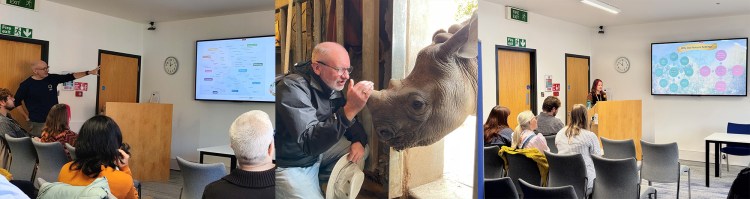
Left and middle: Jon Taylor, Director of Conservation Optimism
Right: Trixie Harrison, PhD researcher and neurodiversity specialist
Other in-person sessions included: dog show, pangolins, the Boy Wonder ethical clothing brand, a beautiful poem titled ‘Nine Spoons’, the joy of exploring the archives, and life writing through spoken word poetry. Our online attendees were treated to focus baskets and sensory snacks, an introduction to the Emotional Freedom Technique (EFT), a recording of the ‘Nine Spoons’ poem, and the benefits of having a neurodivergent brain in research design.
No festival of this kind would be complete without lots of ‘things’ to explore and we had both an online art exhibition and a range of in-person stands, including zines, vintage dolls, weaving, doodle art, ethical clothing, vintage teacups (with hidden pictures, revealed by a light!) and dog showing delights. The in-person sessions were captured in a SketchNote and shared with both online and in-person attendees in the closing session.
A selection of the in-person exhibition stands.
Some delightful feedback from the day shows that this really filled a gap for our neurodivergent comrades, helping us to make new connections and strengthen our community.
“Massive thank you. I didn’t realise how much I needed to feel accepted and just have fun with other ND people.”
“I really appreciated the point that this was for us, not about us.”
“It really stood out how inclusive the sessions felt and how well balanced the online/in-person elements were. I joined online and didn’t feel left out at all.”
“[What most stood out on the day was] people’s kindness and laid-back atmosphere.”
“Felt I could really be ‘myself’ – probably the most authentic I’ve ever been at work!”
This is exactly what we wanted to create when we set out on the SpoonFest journey. We’re so grateful to everyone who helped us make this a reality on the day.
So what’s next? Will we be back next year? We’re working on that. We’re listening to feedback and sharing our experience more widely to explore ways to build on what we achieved this year.
| The event team was: Trixie Harrison, Jurgi Giraud, Claire Davies and Vicky Bowskill. We would like to say a huge thank you to everyone who attended, exhibited, spoke or otherwise contributed to making this day such a success. We are also grateful to Centre for the Study of Global Development (CSGD) for sponsoring our lunch and to the Faculty of Wellbeing, Education and Language Studies (WELS) for providing our morning and afternoon refreshments. |
 Inklusive Nature CIC
2 thoughts on “SpoonFest: a festival of neurodivergent projects and passions”